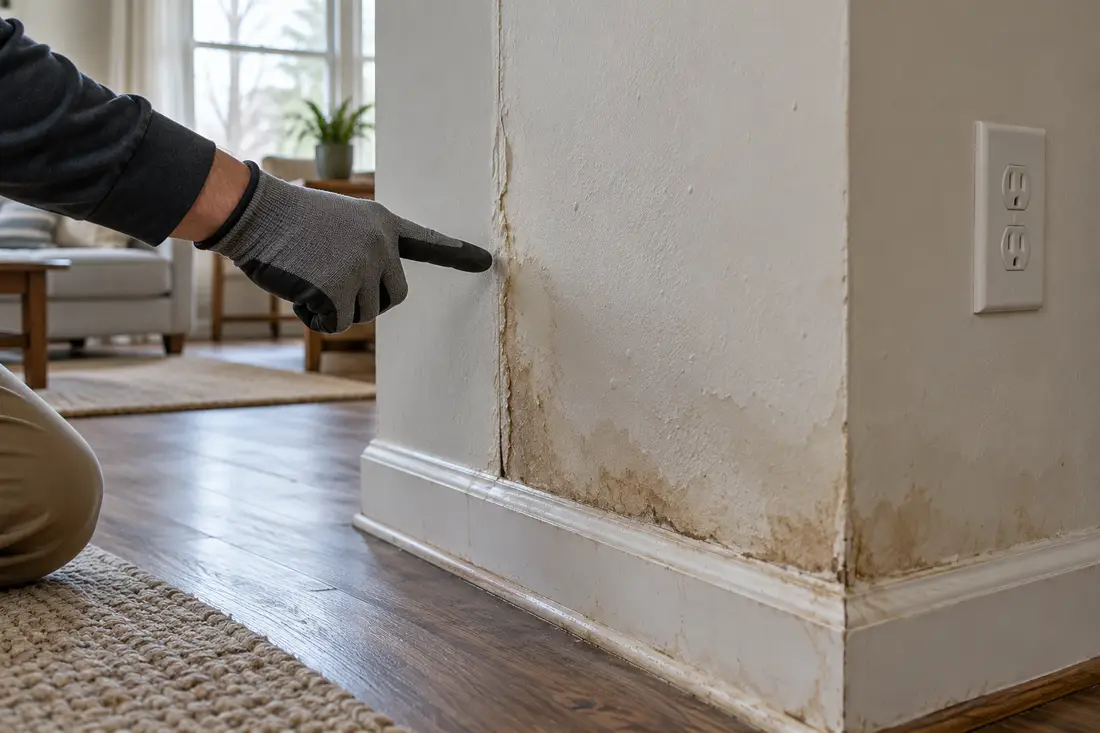
Quick answer
Some intact drywall affected by clean water may be dried in place. Sewage or floodwater contamination requires a different decision. Ask a qualified provider to document the source, condition and proposed scope before you approve removal or covering the wall.
When drying in place may be considered
EPA’s clean-water response table allows for drying wallboard in place when there is no obvious swelling and the seams remain intact. Otherwise it recommends removal and replacement. This is conditional guidance for clean-water damage; it is not permission to retain every stained wall. Ask the provider to explain which condition it observed and which guidance it is applying.
Sources: [1]
Why floodwater and sewage change the decision
CDC recommends discarding drywall and insulation contaminated by sewage or floodwater. That is a different situation from the clean-water example above. Tell the assessor if outdoor flooding or a backup may be involved; a cosmetic stain alone does not establish the source or the extent of contamination.
Sources: [2]
The wall surface is only part of the assessment
NDSU Extension cautions that a wall can feel dry while the inside remains wet, and that wet insulation may need removal. Ask how the proposal addresses the wall assembly rather than only its paint finish. Do not interpret this article as instructions to open a cavity yourself or choose a universal cutting height.
Sources: [3]
Request a room-by-room decision record
For each affected wall, ask the provider to identify what it proposes to keep, investigate or remove. A marked photograph can make the discussion easier to follow. Keep the original images and the written explanation with your authorization. If different walls receive different recommendations, ask why rather than assuming one method suits the whole house.
- What is known about the water source?
- What visible condition supports the recommendation?
- How will the cavity and insulation be assessed?
- Which removal and rebuilding tasks are included?
- Who will confirm readiness for replacement materials?
Before approving a flood cut or repainting
Ask how the provider chose the proposed extent of removal and how it will document an unexpected finding. Clarify whether the price includes debris handling, insulation, replacement board and finishes. A proposal that only says wall repair leaves several decisions unclear. Request those details before work starts, especially when the person authorizing work is different from the tenant or occupant.
Keep the decision property-specific
These source distinctions help you ask better questions; they do not diagnose your wall. An assessor may need access, measurements and information about the building before making a recommendation. If the scope changes, obtain a revised explanation and price rather than assuming the original estimate already includes the additional work.
Questions you may have
Does every water stain mean drywall must be removed?
No. A stain alone does not settle the decision. Ask about the source, board condition, contamination and the assessment behind the wall.
Should I cut a fixed height above every water line?
A universal cutting height is not established by this article. Ask a qualified provider to define and explain the removal scope for the affected assembly.
Sources & further reading
Official resources used to prepare this page. Their inclusion does not imply affiliation or endorsement.
Ready for a more informed conversation?
Use our checklist, understand the scope and confirm availability directly.
See connection options ↗